This page is about some of the approaches I have been taking in developing my artwork. It is not comprehensive, just a bit of an insight into an on-going process. Specific technical questions and challenges will from now on appear in my Posts.

“LOOSEN UP!” I am constantly being told that I need to loosen up with my landscapes. This is a complex question for me. I paint in a realist-impressionist style. I don’t want to reproduce the actuality of a scene, nothing like hyper-reality, but I want to convey the sense of a place, the feeling of the encounter between my own being and the world on one particular day and time. I don’t want it to be abstract. I want the viewer to see a tree, if a tree is there. I love the ‘loose’ techniques of Elisabeth Cummings or Luke Sciberras, but that’s not what I want to do, or not yet. I have been reading a lot about the history of landscape painting, and thinking about what the landscape itself means to me. I think I know what I want to do, but I may be going about the task in the wrong way. Some of this can be attributed to my classes at TAFE, but not all.
So, in a spirit of self-examination, I have been thinking about the whole process of what happens when I come to do a painting. This really only applies to oil paintings since 2015/6. My TAFE work and the earlier work while at the Petersham studio was approached differently, in some ways with a greater level of abstraction, but even so, it still wasn’t “loose”.
Every oil painting I work on belongs to a series or a theme. This is determined by the place I have been, from which each painting comes. So almost all my paintings to date have been part of “suites” belonging to specific places. The first and most obvious is the upper Blue Mountains and certain sites, especially in the Megalong Valley and some in the Hartley area. I I have also done one major painting based on a trip to Hill End, even though that painting did not depict Hill End but rather a rural road which ran away towards a different town. The other major site is Capertee Valley, which I am still working on. A second series came from a trip to Broken Hill with Obelia, with visits to Silverton and Menindee. More recently I have been painting scenes from the Lane Cover River near Sydney. I will write a post shortly on my art-writing site about Piguenit, to whom I am dedicating this series, it is such an interesting story. (The link will go here when it is live).
While I do some plein air sketching and painting, I also take a lot of photographs, and each of my major paintings is based on an identifiable photograph from my collection. I have not tried to paint anyone else’s views, although am thinking of doing a series based on early artists’ sketches of various sites, which are so interesting. Having selected the image, I then try to follow the same series of steps.
If I have painted the scene en plein air it will be on smallish canvas boards in oil or sometimes acrylic. I hate painting on these boards, hate the stiffness of them and the unpleasant texture, but for outdoors work they are the only thing that is really practical. I have recently been working hard to improve on these pictures, to make them “sing” more, they always seem a bit flat and boring even though they can look really good on the wall in a frame.
First I try to do one or more pencil sketches, or somethings a gouache sketch, looking at the shapes and forms, depending on horizontal or vertical compositions. These might be closely related to the photograph, or diverge a fair bit from it. I don’t try to do an accurate rendering using any kind of grid or other projection. The shapes are sketched in and may need adjustment with an eraser but in the end they are just a simple sketch. I then take the same image and finish a fairly loose quick painting using acrylic on paper to capture the composition better, considering the light, the best palette for the scene and so on. These are proper pictures on 300 gsm watercolour or mixed media paper, no larger than A3 size, some smaller. I have shown and sold quite a few of these pictures much later, after the final picture is completed. If I ever do anything “loose” this is it.

After that I scale up to a larger picture on canvas using acrylic. I use a good pre-stretched canvas from an art store, on a narrow frame, usually 16 x 20 ins or 18 x 24 depending on the scene. Recently I have also tried thicker Fredrix artists boards. These come out quite well, but nothing like a genuine oil. There’s something flat about acrylic, no matter what you do.
Finally, if I still like the picture enough, I move onto the oil. I use only really good quality oils. I used to use a variety of medium quality paints especially when I was at TAFE but I would never do that again. Working in oil is so special and specific, especially wet on wet with a limited palette, you just can’t do anything with poor quality low density paints. I am finding Windsor and Newton paints to be of much lower quality lately and don’t buy them any more except maybe for one or two particular colours.
So, to the main oil painting, which is the principle reason for all this effort. It might be quite small, or as large as 24 x 30 ins (61 x 76 cms) but I am not even trying to work on anything larger than that these days because I have no studio to work in and it’s impossible to paint without space to move around the painting. If I ever get a real studio again I do want to try a larger-scale oil on canvas or if I win the lottery oil on Belgian linen, it is by far the loveliest thing to paint on but so expensive and given that nobody is buying my paintings I really can’t afford it.
By now I should know the shapes of the images and outlines of the composition by heart but even so there can be surprises and they don’t work out on the canvas as they did on the paper. Maybe because the sizes are not identical – there’s guess work no matter which way you do it. I do not underpaint the canvas. There are reasons for this, to be discussed in a future post. I put the approximate outlines in first with a smallish brush using using a thinned burnt umber or maybe ultramarine. If these shapes seem approximately right, I then put in the darks – places where dense shadows are evident, dark trees, anything else which will be at the lowest end of the spectrum. After that, other main areas are blocked in.
There are a lot of different ways to do this, using different colours depending on the scene. If it is of an open valley with dense grasses or bushes in the foreground a dark reddish purple can be brushed loosely over that whole area. A different undercolour, or more than one, goes where the grasses and hillsides are. Sky can be underpainted in at this stage also, but it will be changed in accordance with how intense it needs to be, how much cloud there is and where the light reflects from the clouds. Because I no longer use any thinner or spirits, all this has to be done with a light mixture of paint and oil – walnut or linseed probably.
There are a couple of Gamsol products which can be used to mix that first layer, eg Gamsol Solvent Free Gel can be used to dilute oils but it still does not create that free-flowing underpainting which turpenoid or gum turps does so well. If you do the first layer with only oil, then you must wait for several days for it to dry before you can go back to that painting.
Here is where the real tough stuff happens. I want to paint the essence of the scene. It needs to be like the scene. I don’t want to move the road, or put in a house, or add spare bushes or a pond, just to make the picture look better. BUT here is the problem: everyone says “You are making a painting, it is not real”.
When artists do produce absolutely realistic pictures, which look like a photograph, I admire the skill but see no purpose to that. The painting has to say something more than a photograph would, it has to reference the beauty or the challenge of the real which it is depicting, but also express something about the weather, the feeling of the place at that season, as well as the emotion of the artist, if such a thing is possible.
I want to respect the shapes and forms of the earth and its characteristics, its rocks, the way the trees glitter or shine in the setting sun, the way the light bathes the beauty of the earth which shares itself with the viewer from so many different perspectives and angles. But as to the detail of how to make that happen – that is the mystery! I find myself getting closer and closer to the surface of the canvas. I find my brushes getting smaller, the details on the trees coming forward, the shapes of shadows on the saplings, all of this has to be somehow brought forward into a total view.
So after hours of labour over several days, waiting for layer after layer to dry, I stand back and look at the picture and I think I see what I was getting at but still it looks formal and stiff. I don’t want to start again or throw the painting away, but now I don’t know what to do with it.
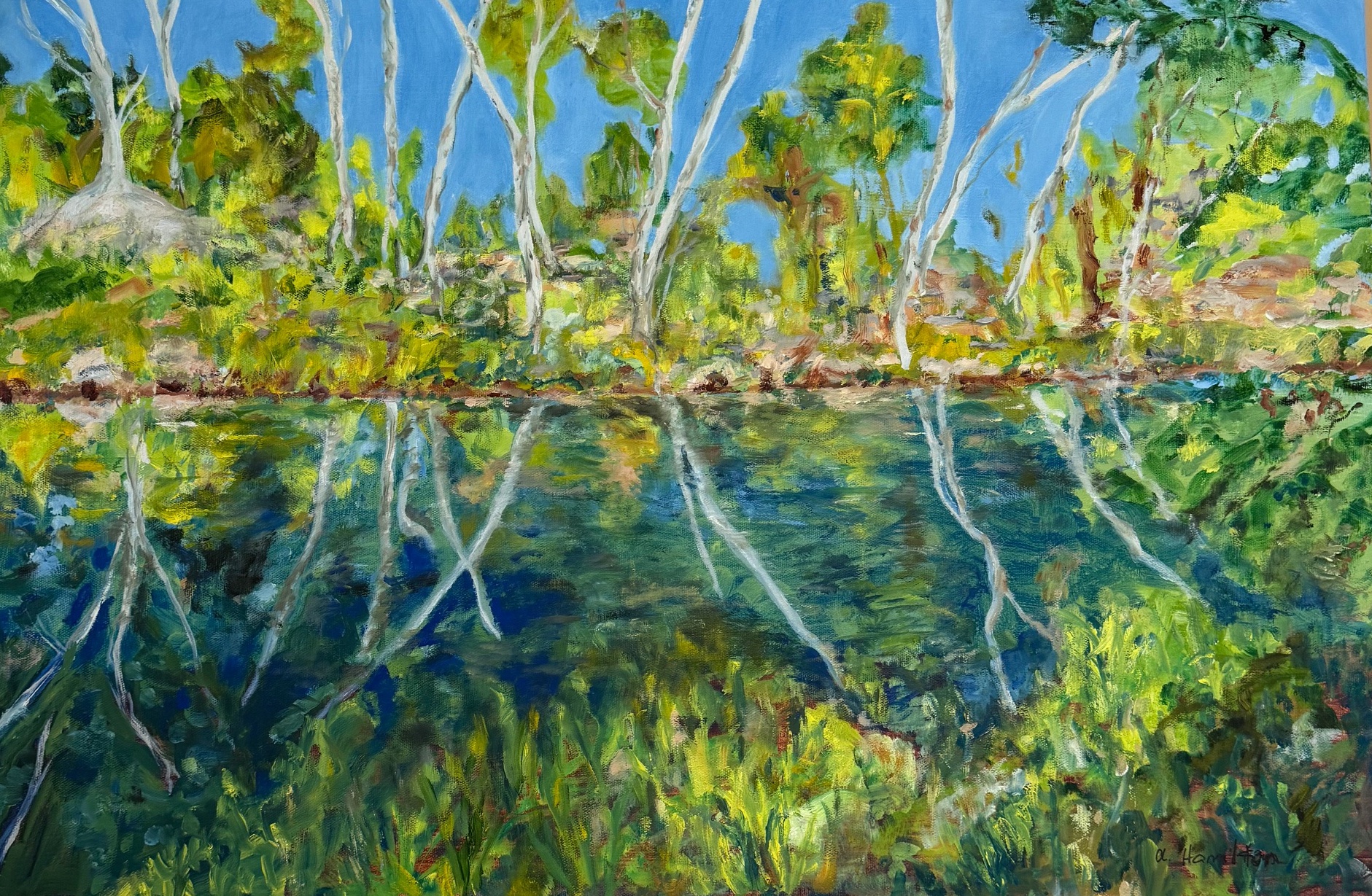
How do others go about the construction of their works? What does it mean when artists (especially art teachers) say so constantly that you should paint “looser”? I wish more people would talk about it openly, or show how they go about it.
 Annette Hamilton - Artist